The author would like to suggest to the readers that The Countdown Clock would make a wonderful listening companion for this article!
Every Opportunity Feels Like ‘The One’
If I were ever asked in an interview what my biggest weakness is, my answer would be entirely honest: I overwork. I put too much pressure on myself and those around me because I constantly feel every second slipping away, always waiting for it all to catch up with me.
I think the root of this tension is that I imagined myself at this age to be far more accomplished than I actually am. I’m in my mid-20s, yet I always feel miles behind where I should be, or where I could be, if I just wrote more, networked more, worked harder, and applied to more opportunities.
To me, every opportunity feels like a necessity. Any event I don’t attend, any project I pass on, is instantly categorised as the ‘one’ where I was supposed to get my big break.
This genuinely sounds like one of those humble-brag answers you give to an interviewer to look good, and I suppose it works well enough for hiring purposes. But in reality, it isn’t a good thing. It is frequently debilitating. I work too hard, and I’ve had to put serious effort into becoming a better team player, learning to find genuine value in collaboration rather than viewing it as a hindrance I had to tolerate. I can honestly say I love working in teams now, but it is an appreciation I’ve had to consciously build.

Lost Time
And yet, that core fear of wasting time persists. It is not something I’ve ever managed to fully get around. Even now, knowing that I overwork, I still struggle to sit still. I feel empty without constant, material proof that I am actively building toward something.
If I had to guess where some of this urgency comes from, I’d point to last year. I was ill for a long stretch of time; long enough that large parts of the year now feel strangely absent. There are months that seem to exist only as a blur of medical appointments, symptoms, and half-remembered conversations.
Maybe on some level, I’ve been trying to make up for that lost period. Maybe I feel like a year of my youth was stolen from me, and I am now desperate to claw my way back on track.
But if I am being entirely honest with myself, I was quite like this before I got sick. I was always doing something, always trying to make my value known, useful, and appreciated. Perhaps my illness wasn’t the catalyst after all – it simply magnified a pattern that had already been there for years.
What Counts As Wasted Time?
It is telling that I’ve spent the majority of this piece talking about my career, my potential, and my desire to control every possible avenue of my future. It is weird that I automatically defaulted to professional ambition when writing about the fear of wasting time.
Because ‘wasting time’ can mean so many things.
It could mean missing the chance to watch my four-year-old nephew grow up. It could mean failing to call my friends to keep in touch, failing to be an active listener, or failing to prioritise personal and emotional growth over a career.
In my head, these are the moments I should be terrified of wasting. But they aren’t. Or, at least, they weren’t the first things that came to my mind. And isn’t that a revelation in itself?
The Comfort of Productivity
I suppose the next question is why my career has occupied so much space in my thinking. Why does every spare moment feel as though it must be directed toward proving my worth?
The uncomfortable truth is that I don’t entirely dislike it.
While the fear of wasting time feels unpleasant, the act of productivity feels incredibly reassuring. It creates the illusion that things are moving forward and that the future is somehow under control. Perhaps that is why the fear never truly disappears; it is fuel. After all, the whole point of fearing wasted time is that you get to feel a rush of self-righteous satisfaction when you convince yourself you’re not wasting it.
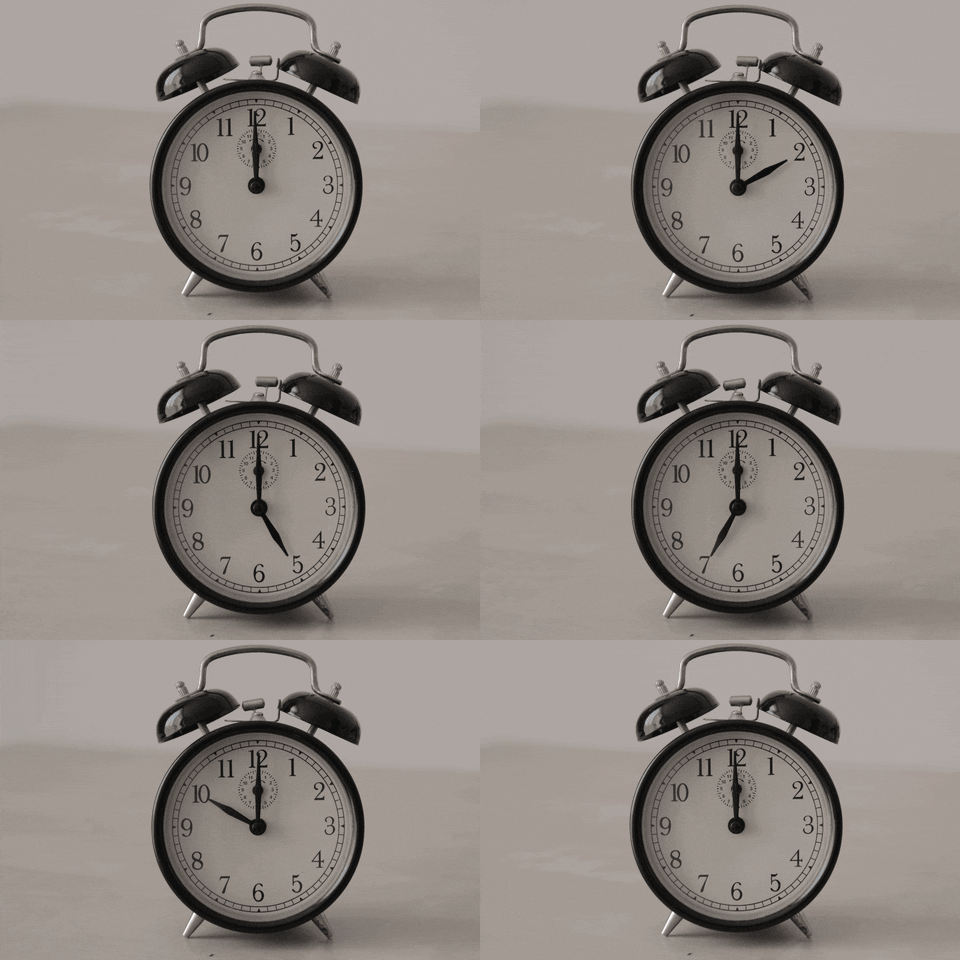
It’s a fragile sort of comfort. The deeper truth is that by treating every second as a transaction to buy future security, I risk bankrupting my present. If I only value the hours that produce a tangible result or a CV line, I am voluntarily erasing the very things that make a life worth living in the first place – the unstructured afternoons, and the spaces where I don’t have to prove my worth to anyone.
I haven’t cured myself of this anxiety; I still feel somewhat sick at the sight of an empty calendar. But I am trying to renegotiate my relationship with the clock.
Maybe the real art of not wasting time isn’t about running faster to catch up to some imaginary, more accomplished version of myself. Maybe it’s simply about slowing down enough to realise that the life I’m so afraid of wasting is already happening, right now, whether I am working or not.