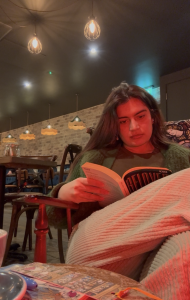
Okay, to clarify, the book in this picture, Beloved, I have actually read.
Did I love this book? Yes.
Is this photo performative? Of course it is.
Did I read the book because I wanted to appear intellectual and well-read? Brutally honest answer: I genuinely don’t know.
But I am still glad I read it, and I do think it’s a brilliant novel.
It did get me thinking, though, about the performance of being “well-read”, and the difference between that and simply reading well.
At the risk of being painfully on the nose, I’m going to start with a quote from Haruki Murakami:
“If you only read the books that everyone else is reading, you can only think what everyone else is thinking.”
Ironically, this comes from Norwegian Wood, a massively popular bestseller that has itself become part of the modern literary canon.
And while I understand what Murakami means, I’m not convinced I fully buy into the mentality behind it.
I’m not convinced that reading obscure books necessarily produces original thought.
I do think reading matters. I think books have power, purpose, emotional weight, and a significance that’s often underestimated. But I don’t think reading difficult literature automatically grants access to some higher state of intellectual individuality. If anything, the desire to appear intellectually unique can become its own kind of performance.
And I’m probably not exempt from that.
How Individual Can I Be?
As much as I’d like to think I’m entirely original, I’m not. None of us are.
I am a product of upbringing, environment, algorithms, education, conversations overheard in cafés, essays I half-read at university, bloody TikTok, films I watched too young, and every person I’ve ever loved or argued with. Every part of us is shaped by influence in some way.
Which is why I’ve always struggled with the idea of purely “original” thought in the first place.
There’s a reason people argue that every story ultimately fits into a handful of archetypes. Human beings recycle ideas constantly. We reshape them, reinterpret them, modernise them slightly, and then present them back to the world as something new.
Books do the same thing. Even obscure literature exists within traditions, influences, and repeated themes.
Which is partly why I’ve also struggled with the idea of universally “essential” books.
The ‘Different Book’ Phenomenon
Take Blood Meridian.
I think it’s extraordinary. Brutal, unsettling, and probably some of the best prose I can remember reading.
A friend of mine, meanwhile, thought it was violent, repetitive, boring, and borderline unreadable.
And neither of us is wrong.
That’s the thing I keep coming back to whenever people talk about literary “masterpieces”. We don’t all have the same brain. We don’t approach books with the same experiences, interests, emotions, or memories. A novel can completely alter one reader and leave another entirely cold.
Because of that, literary prestige has always felt slightly unstable to me.
Yes, some books are historically significant, beautifully written, culturally important. But the meaning we take from them is always personal.
A masterpiece is still partially created by the reader.
The Spag-Bol Theory
This next part contains one of the most disgusting metaphors I’ve ever willingly written down, but unfortunately, I think it works.
If someone ever asked me what the best food to throw up is, I would say spaghetti bolognese. It tastes good going in, and somehow not entirely horrific coming back out. There’s enough resemblance to the original thing that your brain still recognises it.
It’s a revolting image, I admit, but it makes sense in my head.
The “Spag-Bol Theory”, unfortunately, is my belief that most human thought is just regurgitated culture.
The books we read, films we watch, conversations we have, opinions we absorb online, things teachers say at sixteen that stick forever — all of it gets processed internally and repeated back in slightly altered forms. We consume ideas, digest them, and reproduce them in our own voice.
Which brings me back to the Murakami quote.
If all thought is influenced by external material anyway, why are some influences treated as more intellectually legitimate than others? Why does reading obscure fiction supposedly make someone more independent-minded than reading popular fiction? And who decides what counts as “real” reading in the first place?
Norwegian Wood is itself hugely popular. Does that make its ideas less valuable? Does popularity automatically dilute meaning? Should I dismiss this entire article because other people might agree with it?
Do you see my point?
Because I don’t think popularity and intellectual value are opposites. I think sometimes people have niche tastes in exactly the same way others prefer mainstream tastes. One just sounds better at dinner parties.
So What Actually Matters?
Which leaves the obvious question: if reading is not about prestige, originality, or appearing intelligent, then what is it actually for?
Truthfully, I can only answer that personally.
I read because I enjoy it. I enjoy the slowness, the quiet focus, the way imagination is required rather than constantly supplied. Words feel more intimate to me than visual media does. Not better — just different.
I also read because books became a kind of comfort early on. I taught myself to read because it wasn’t particularly encouraged when I was younger, and somewhere along the line, it became both escapism and stability. I read constantly as a teenager because it gave me somewhere to disappear into when I needed it. I think part of me is still holding onto that now.
And yes, sometimes I read because being seen with a “high-brow” novel like Beloved makes me feel more intelligent than I probably am.
I’m not proud of that impulse, but pretending I’m above it would just be another performance.
Which is why I resonate with a quote from Kurt Cobain:
“I’m not well-read, but when I read, I read well.”
I think that feels more honest.
Maybe reading was never about becoming the most intelligent person in the room. Maybe it was about finding fragments of yourself in unexpected places — a sentence, a character, a feeling, an idea that lingers longer than it should.
And I think that matters more than whether the book was obscure enough to make me seem interesting for reading it.