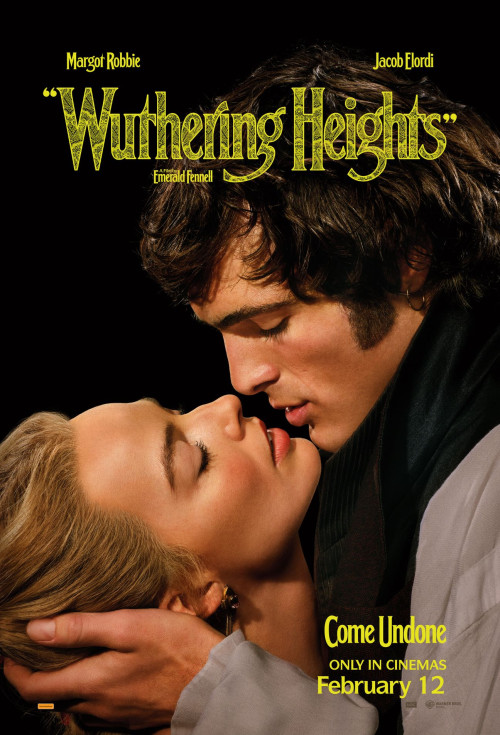
Everyone has been talking about the new Wuthering Heights, starring Margot Robbie and Jacob Elordi, and it has got me thinking about modern adaptations, and why they even exist.
I mean, think about it. There’s Romeo + Juliet, Hamlet, The Canterbury Tales, Little Women – the list goes on, and on, and on.
And why is that? It can’t be solely for nostalgia, although I do think that plays a part. Perhaps it’s partly nostalgia, partly the appeal of returning to stories that have already proved they work. After all, why fix what isn’t broken?
But nostalgia looks backwards. Adaptation, really, does something else; it brings those stories forward.
To be honest, I think it’s about the consistency of the human condition. Whether we live in the 16th century, or 2026, we all experience the same core emotions – hope, loss, betrayal, desire, you name it. These feelings, in a constantly changing world, feel remarkably unremarkable. They don’t disappear, they just find new settings.
And that, I think, is why these stories don’t stay in the past.
When you look at literary movements in particular, this becomes even clearer. They offer a kind of framework, a space where these emotions can be explored, stretched, and reinterpreted without ever really changing at their core.
Gothic as Emotional Outlet
Take Gothic literature, which I’m using as an umbrella for all Gothic writing. It emerged in the 18th century in response to the Enlightenment, creating a space where people could explore anxiety, fear, and a growing distrust of the seemingly rational world around them.
When you think of Gothic, you might think of Frankenstein, Wuthering Heights, or even The Haunting of Hill House. None of these texts resolve fear, but rather, they sit with it. Instead of fixing the impossible, they expose it for what it is: lingering, unresolved, and disturbingly human
And that’s exactly why they continue to be adapted.
Because that feeling, that quiet sense that something isn’t right, hasn’t gone anywhere.
The Gothic has evolved, shifted, and embedded itself across different forms of media. Yes, there are the classics, but there are also films like The Shining, The Nun, and even Casper. Different tones and different audiences, but always the same underlying instinct.
This isn’t really about listing Gothic texts. It’s about why the genre exists, and most importantly, why it persists.
I think the Gothic offers a way to both confront and escape uncertainty. It gives shape to something otherwise intangible; the sense that there is something beyond our control, beyond our understanding, lurking just underneath the surface of ordinary life.
“The oldest and strongest emotion of mankind is fear, and the oldest and strongest kind of fear is fear of the unknown.” — H. P. Lovecraft
If that fear is still with us (and it clearly is), then it makes sense that we keep returning to the stories that know how to express it.

If Gothic externalises fear, then other literary movements take that same instinct and sharpen it in different ways.
Dystopian as Social Warning
Dystopian fiction, particularly as a post-war movement, does something similar, but with a different focus. Where Gothic turns inward, dystopia turns outward. It takes that same anxiety and projects it onto systems, governments, and entire societies.
From Nineteen Eighty-Four, to The Hunger Games, to The Handmaid’s Tale, dystopian fiction doesn’t just entertain, but warns. It exaggerates, distorts, and reflects real fears about power, control, and the fragility of freedom.
And again, that isn’t new.
Writers have always found ways to critique the world around them. William Shakespeare explored autocracy through the lens of the Danish court, while John Webster exposed issues of patriarchy and class through the Italian court. The setting changes, but the impulse doesn’t.
What dystopia does, though, is make that impulse unmistakable. It takes the fear of the unknown and gives it structure. It says: what if the thing you’re worried about isn’t hidden at all? What if it’s already here?
And just like the Gothic, that’s why it keeps being revisited, reimagined, and adapted. Because those fears don’t disappear. They evolve alongside us.
Where Does That Leave Us?
So maybe adaptations don’t exist because we’re nostalgic, or even because these stories are “classics” in the traditional sense.
Maybe they exist because they’re still accurate.
The world changes — settings, language, technology — but the emotional core doesn’t. The fear that drives the Gothic, the anxiety that shapes dystopia, the desire, grief, and longing that sit at the centre of so many of these texts, all of it remains.
What adaptations do isn’t simply retelling old stories. They translate them. They take something that has always been true and make sure it still makes sense now.
Which is why we keep returning to them.
Not because they’re old, but because they haven’t stopped being relevant.