We all know that person. The one who seems to move through life untouched by friction. They are successful, composed, and attractive in a way that looks unstudied. Things appear to fall into place for them. They do not seem to struggle.
They look effortless.
It is difficult to root for someone like that. Easier, perhaps, to envy them. Easier still to resent them. Luck feels like an unfair advantage when you are the one working for every inch.
But I am beginning to think that this kind of person does not really exist. Effortlessness is not a trait but rather a performance we misread.
There is a familiar analogy often used to describe this: the duck gliding across water, calm and untroubled, while beneath the surface its feet move rapidly just to keep it afloat.
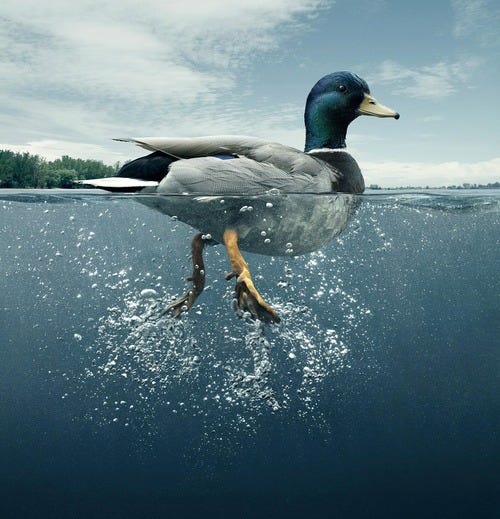
It is a useful image, but I also think it’s incomplete. We tend to assume that we are the only ones who feel the strain, and that everyone else is simply better at staying above the surface.
Take Wellington Treads. On the surface, it appears fully formed: a complete website, a consistent tone, something that looks as though it arrived all at once. But that version hides the reality of its making. The hours spent trying to understand hosting, metadata, and fragments of code that refused to cooperate. The full day I lost attempting to migrate data that simply would not move; a day that felt wasted, demoralising, and entirely unproductive.
None of that is visible. What is visible is the finished version. The part that looks easy. I think this is where the myth takes hold, when we see the surface and assume it tells the whole story.
Of course, it’s easy for me to say this now, but I find myself complicit in maintaining this facade.
As I move into freelance work and into spaces that feel new and uncertain, I notice how quickly I begin to perform a version of myself. At networking events, I look around and see people who appear entirely at ease. They are articulate, well-connected, and interesting. They seem to belong without effort. They know people I do not know. They have momentum that I am still trying to build. I assume that what I am seeing is real.
I then think about how I appear in those same rooms.
I choose heels so that I am heard before I am seen. I make sure I do not look tired. I joke, I speak easily, I present myself as settled, confident, someone who belongs in that space. On the surface, I become the very thing I am questioning. Someone else, looking at me, might see ease.
They would not see the calculation behind it. Or the uncertainty. Or the effort it takes to maintain that version of myself for an evening.
Perhaps this is the contradiction at the centre of it. We distrust the appearance of effortlessness in others, while carefully constructing it in ourselves.
So the question is not whether effortless people exist but why we continue to believe in them.
I find myself wondering what might happen if we stopped trying to look like we are floating and admitted that we are all still learning how to stay above the surface.